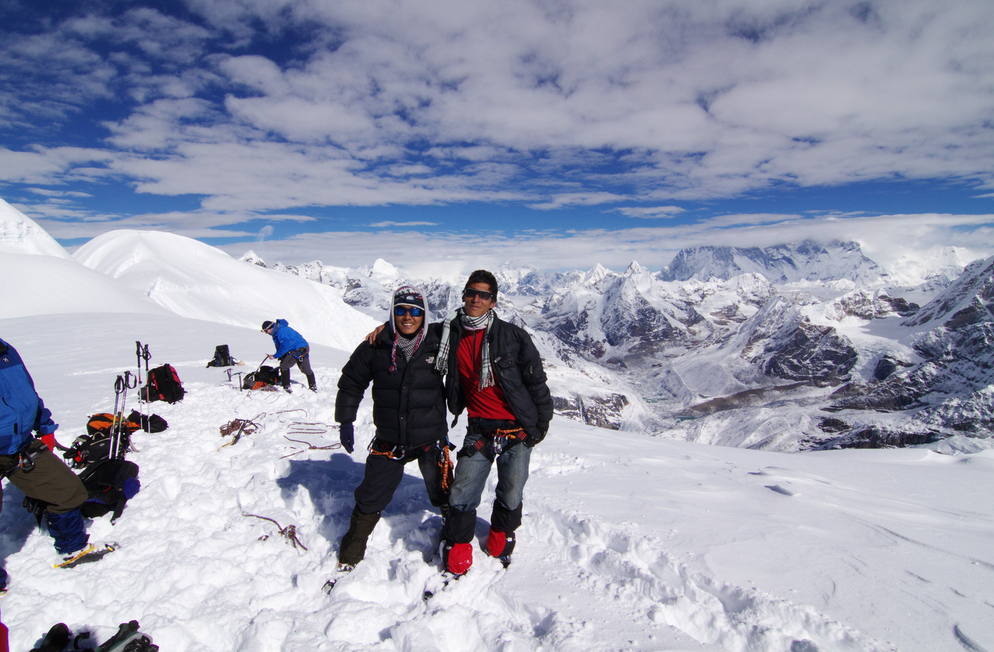
Mera Peak climbing preparations do not begin when you are in Nepal or when you put on your backpack. It starts silently, usually months before, in day-to-day life, in your thinking, and your discipline. Mera Peak is the highest peak in Nepal, and it stands at 6,476 meters and is situated in the remote Hinku Valley. It is sometimes called a non-technical peak, which may be misleading.
Although it does not entail technical rock climbing, it involves essential mountaineering skills like the use of crampons, ropes and an ice axe. It is a high-altitude climb that must be taken seriously, requiring preparation, awareness, and respect because of glacier travel, concealed crevasses, and steep snow slopes.
Reaching the summit of Mera Peak also involves official permits and is generally accompanied by a licensed guide in Nepal, which also supports the idea that this is not just a trek, but a regulated mountaineering expedition.
Mera Peak is not only unique due to the high point but also the process of getting there. It is a long, distant way, through forests and rivers and suspension bridges and high alpine valleys of the Himalayas where human presence is rare. You gradually pass through the villages of low altitudes to a world of ice, glaciers and silence. It is not a mere physical change; it is both emotional and psychological.
When you are planning to record this experience in the form of a vlog, then preparation becomes even more significant. You are not training to climb, you are creating a story, one step at a time.
All hikes, all workouts, all equipment choices, all moments of indecisiveness become a part of your story. This guide is composed as a vlog script and can make you see the entire preparation process in a realistic, detailed and storytelling manner.
Physical Preparation- Building a Body that can withstand the Himalayas.
Endurance Training – The Basis of It All.
Endurance is the most crucial physical need related to Mera Peak. Your walks will be long, day after day, sometimes in rough ground, with gradual, but steady increase of elevation. It is not the speed that is the challenge, but consistency. You must learn to keep moving despite feeling fatigued to train your body. A constant speed also contributes to the fortification of the cardiovascular system, and the ability to endure a long distance hiking contributes to the development of stamina of trekking. Cycling and climbing stairs are also a good alternative particularly when you do not find any mountains around.
Long weekend hikes are one of the best training with 4-6 hours of non-stop walking. As time goes by, your body becomes accustomed to long-term work, and you become more tolerant to fatigue. The idea is to ensure that long walks do not seem tiring but rather normal.
Strength Training -Helping Your Body with Load.
Endurance will keep you going, whereas strength training will keep you steady and injury-free. On Mera Peak, your legs are supporting your weight with the weight of a backpack and this is usually on rugged ground. In the absence of adequate strength, fatigue comes very fast.
The training should target legs, core and lower back. The squats, lunges, step-ups and planks are very effective exercises. Having a strong core is particularly desirable since it aids in balancing the action in walking through rocky paths or on ice.
It is strongly advisable to wear a weighted backpack when training. This is an imitation of actual trekking conditions and will train your shoulders, hips and knees to the actual expedition weight. It might be awkward initially but your body gets used to it and is more effective with time.
Flexibility and Prevention of Injuries.
The aspect of flexibility is commonly overlooked yet contributes significantly to the prevention of injuries. Strict muscles may cause pain when there is a long descent or a steep climb.
Stretching exercises or yoga can enhance flexibility and make your muscles heal sooner. Target hamstrings, calves, hips and lower back. A few minutes of daily stretching (even 15-20 minutes) can be felt during the long days of trekking.
Mental Preparation – The least considered obstacle.
Coming to terms with Slowness and Discomfort.
Slow down learning is one of the largest psychological adaptations in Mera Peak climbing. When in high elevation, everything is slower; walking, breathing, thinking and even recovery. Most climbers do not have the problem of being weak physically, it is the problem of being slow.
Mental preparation involves being prepared that you will not get speed in the mountains. Rather, you have to adjust to the beat of altitude. The whole process becomes easier and more manageable as soon as you quit struggling with the speed and begin to accept it.
Building Mental Resilience
The Himalayas are unpredictable. The changing weather, the long days of trekking, physical exhaustion and loneliness all ask your mind. The preparation of this is to expose yourself to uncomfortable conditions before the journey.
One way to do this is to go on long hikes by yourself, to train in bad weather, to push through tiring days rather than to call it a day early. It is these experiences that will condition your mind to go on even when circumstances are not ideal. Mental resilience cannot be made in comfort, it is made in little moments of difficulty over a period of time.
Emotional stability at the Expedition.
Emotional ups and downs are part of the nature of long expeditions. There are days which are exciting and full of energy and others which are exhausting and mentally draining. This is something to know ahead of time so that you can be grounded. You get to know that being tired, fed up or even uncertain is all a part of the process. You do not respond emotionally but you keep on moving.
Knowing Altitude The Unseen Power of Mountain.
The effect of altitude on the body.
The most important parameter of Mera Peak climbing is the altitude. The air pressure decreases with altitude, reducing the amount of usable oxygen available to your body, especially above 3,000 meters. Your body reacts by raising the rate of breathing and heart rate.
The effects are felt more above 5,000 meters.
Basic activities become more difficult, it takes more time to recover and the energy level is becoming more intermittent. Knowing this in advance can aid you to read your body language right.
Acclimatization the secret of staying alive and winning.
The act of getting used to low oxygenation is known as acclimatization. It is not optional—it is essential.
An adequate Mera Peak schedule comprises gradual ascent and rest days. These rest days enable your body to get used to it. In their absence, chances of altitude sickness are high.
It is a simple principle; go high and sleep low and never hurry the job. One of the most significant elements of preparation is to respect this rhythm.
Recognizing Altitude Sickness
Prior to the trip, you have to be aware of the danger symptoms of altitude sickness: headache, nausea, dizziness, fatigue, and lack of appetite.
Such symptoms cannot be neglected. When they deteriorate, the safest and most effective response is to descend. The awareness of this fact will contribute to your making safer choices throughout the climb.
Gear Preparation – Your Life Line in Extreme Conditions.
Layering System -Dressing to Change of weather.
The Himalayas weather is never constant and predictable and this is among the first things you must come to terms with when planning Mera Peak. You may spend your morning in a warm sunshine at the lower levels, and your evening in freezing wind or even snow-fall, as you ascend more elevated. This is because of the constant change in temperature and your clothes cannot be fixed or confined to a single kind of temperature.
A layering system is what will make you the most significant means of being comfortable and safe. This is the bottom layer, it comes in direct contact with your skin and it is the one that regulates the moisture levels, it keeps the sweat at bay and thus your body does not get chilled. The insulating layer helps to trap body heat and will keep you warm during rest breaks or cold parts of the trail. Lastly, the outer shell will keep you warm against the wind, snow and rain, your defense against bad weather in the Himalayas.
Flexibility is the actual benefit of layering. You can change your attire with the environment, rather than having one heavy jacket that might not fit all the conditions. This flexibility is necessary as you get further up the mountain since you can be so unlucky that you end up uncomfortable or even severely cold due to the slightest error in the clothing you wear.
Essential Mountaineering Equipment
Even though Mera Peak is usually termed as a trekking peak, it cannot be confused with a mere hike. As soon as you leave base camp and enter into glacier regions, the environment is entirely different. Ice, snow, crevasses, and steep parts demand appropriate mountaineering gear in order to be safe and stable.
Crampons will enable you to walk on the ice without falling and an ice axe will give you support and emergency backup on steep slopes. Safety measures involve a harness and ropes when traversing glaciers, and helmets are used to prevent falling ice, or unintentional slip. All these tools have a particular purpose, and they combine to create your safety system in drastic situations.
But, it is not enough to have this equipment. It is also important to learn how to use it. Confidence can be greatly enhanced even during a brief practice session prior to the expedition. Having known your gears, you move more confidently and with less trepidation, particularly when it comes to crucial times such as summit push or glacier crossings.
In addition to technical equipment, there are a few essential items that are critical for survival at high altitude. An expedition-grade down jacket is necessary to protect against extreme cold, especially during rest periods and summit attempts. Double-insulated mountaineering boots are strongly recommended for proper warmth and compatibility with crampons. A headlamp is essential for early morning summit pushes in complete darkness, and UV-protection sunglasses are crucial to prevent snow blindness caused by intense sunlight reflecting off the glacier.
Footwear – The Greatest Gear Choice.
Of all the equipment you will be carrying, your boots can be considered one of the most important. They are the form of contact between your body and the mountain and all the steps are based on them. Your boots should cope with the long hiking days, the rocky path, the snow roads and the frozen temperatures on Mera Peak.
The best mountaineering boots are those that are waterproof, insulated and capable of supporting crampons. Better still, though, than quality, is familiarity. New boots put on a field trip directly can cause blisters, soreness, and unwarranted suffering, potentially impacting your whole experience.
It is important to break in your boots prior to climbing. Putting them on hikes and training walks will ensure that your feet become used to the shape and will decrease the chances of getting injured. Proper socks, foot care routines, in addition to boots, are also significant in ensuring that your feet are kept warm, dry, and comfortable during the journey.
Trekking Route – Realising the Way of Journey.
Hinku Valley Approach (Remote).
The trip to Mera Peak is neither immediate nor direct, but rather slow-paced initiation into the Himalayas. It starts with a journey to some distant trailheads and then a couple of days of walking through isolated terrains.
This is not only logistical, it is a deliberate one, and your body will adapt gradually to increasing altitude.Further up the Hinku Valley, the landscape is quite different. Thick trees are replaced by open valleys, rivers cut through the rocks, and bridges suspended, linking remote settlements. Life is made easier, less noisy and more in touch with nature.
Such a shift will assist you in psychologically unloading of all contemporary distractions and gradually get into a mountain state of mind.
Facilities are available in the lower sections, but become increasingly limited as you move deeper into the Hinku Valley which is why preparation and self-sufficiency become so crucial. It is not merely trekking; you are traveling through a landscape where resources are limited and valued. High Camps – Life Above Comfort.
When you keep climbing, you ultimately reach high camps, which are much tougher. Such camps tend to be rudimentary, uncovered, and where the winds and cold conditions are strong. The comfort is overridden by survival and functionality.
Now you start to comprehend what it is really like to live high up in the air.
Easy work is more exhausting, sleep becomes less deep and cold is more evident. Nevertheless, this simplicity is the experience as well. It takes away the superfluous distractions and is a concentration on the core survival and locomotion.
It is important to prepare psychologically before this level. Anticipating pain rather than pain relieving habits is easier to adapt to and is in the right frame of mind even during difficult circumstances.
Summit Day -The Last Test.
The summit day is often the most demanding part of the expedition. It normally starts in the early mornings of the day usually before the sunrise, when temperatures are lowest, and the climb includes glacier travel, steep climbs, and constant exposure to cold winds.
This is often the most physically exhausting day of the climb.
It is a test of patience, determination, and mental focus. Each moment is slower, each breath is heavier, every action has to be deliberate.
This is crucial to understand beforehand, as it prepares you mentally to endure but not expect. The mountain is not achieved by rush, it is achieved by perseverance.
Nutrition and Hydration – Energy to stay alive.
Eating at High Altitude
Even when resting at higher levels, more energy is required by your body, and thus, energy demand is very high. Nonetheless, loss of appetite caused by altitude is also one of the challenges that climbers experience. This makes such a case where you have to eat even when you are not even in the mood to eat.
Healthy eating is crucial to staying strong and energetic. Carbohydrates give immediate energy to move, proteins help to build the muscles, and fats give the body energy to move continuously. It is not a matter of choice but a requirement to survive and to perform.
Even small meals consumed in regular intervals are better than big meals consumed in irregular intervals. It is the consistency rather than quantity that is valued.
Hydration -A Perennial Need.
Water is a very important factor in health and altitude performance. When at elevated altitudes, the air is dry, breathing comes quicker and the loss of water in the body is higher than normal. Dehydration may augment fatigue and aggravate symptoms of the altitude.
It is important to drink water on a regular basis even when you do not feel thirsty. Fluids like tea or soups are particularly useful as they keep the body temperature well and at the same time serve to hydrate the body. Electrolytes may also serve to restore minerals lost due to physical exercise.
Staying hydrated is not a single endeavor but a habit that must be realized during the whole expedition.
Striking the right balance between Climbing and Filming.
Balancing between physical work and content creation is one of the largest challenges in the course of the expedition. It may be tiring to film every moment particularly in high altitude where power is scarce.
The most beneficial is to plan the important moments in advance but leave some room to record spontaneously. The balance keeps you in control of what you capture and you do not jeopardize your performance or safety in the climb.
Debriefing- The Mountain Begins Within You.
Training Mera Peak is not about forming body or equipping with gear, it is a process of total change of discipline, attitude and cognizance which gradually develops well before you lay your eyes on the Himalayas. Each run, each hike, each early morning workout and each choice you make concerning your physical condition, your equipment and your state of mind are all a part of the same process that ultimately brings you to the peak.
The significance of this preparation is that it transcends beyond the concept of being at the peak of a high altitude.
Mera Peak is a mirror that reveals just how ready you are not only in regard to stamina and equipment, but also in the way of patience, flexibility, and mental resilience. The mountain never pays off to hurry or push, but to continue, to be modest, and to push through even when things are not comfortable or predictable.
The moment you eventually stand on Mera Peak at 6,476 meters, it is not just about the height you will have gone to or the photo you will have had at the peak. It is of the being that you have made by the way of arriving. The stamina you had gained during training, the self-control you had in moments when you were uninspired, the psychological integrity you have gained in hard times, the respect you had gained of the altitude and nature, all of this is what the true success of climbing becomes.
In the case of a vlog, the real story starts at this stage of preparation. The mountain does not begin in Nepal, but in your day to day life, in your planning, and in your resolution to make the journey a serious one way before the trail is laid. You are not merely a traveler who has come to climb a peak: by the time you come to the Himalayas you are already an individual that the mountain has been shaping long before you laid your eyes on it, and that is the strongest aspect of the whole expedition.